Why Lead Generation for Cleaners Drives Business Growth
Lead generation for cleaners is simply the process of attracting people who need cleaning services and guiding them to become paying clients. In today’s crowded marketplace, a steady flow of quality leads separates thriving cleaning companies from those that struggle to stay booked.
High-impact methods you can start using right away include:
• Google Business Profile optimisation – claim your listing and fill it out completely so you show up in local searches.
• Facebook Groups & LinkedIn outreach – offer helpful tips before you promote your service.
• PPC campaigns – well-targeted Google Ads or Local Services Ads typically cost just $8–25 per lead.
• Reputable lead providers – buy exclusive leads in a tight service radius to avoid bidding wars.
• SEO & content marketing – publish cleaning tips, checklists and before-and-after shots to earn organic traffic.
• Referral programmes – reward happy clients with 20–50 % off for every successful referral.
The owner of one franchise put it perfectly: “Once we dialled in our lead system, the phone hasn’t stopped ringing.” Diversifying your lead sources creates that same stability, protecting you from sudden dips when any single channel slows down.
I’m Kimberle Adamof, founder of Marketing for Cleaning Companies and former maid-service owner. After scaling and selling my own cleaning business, my agency now builds proven lead pipelines for residential, commercial and speciality cleaners nationwide.
Understanding Lead Generation for Cleaners
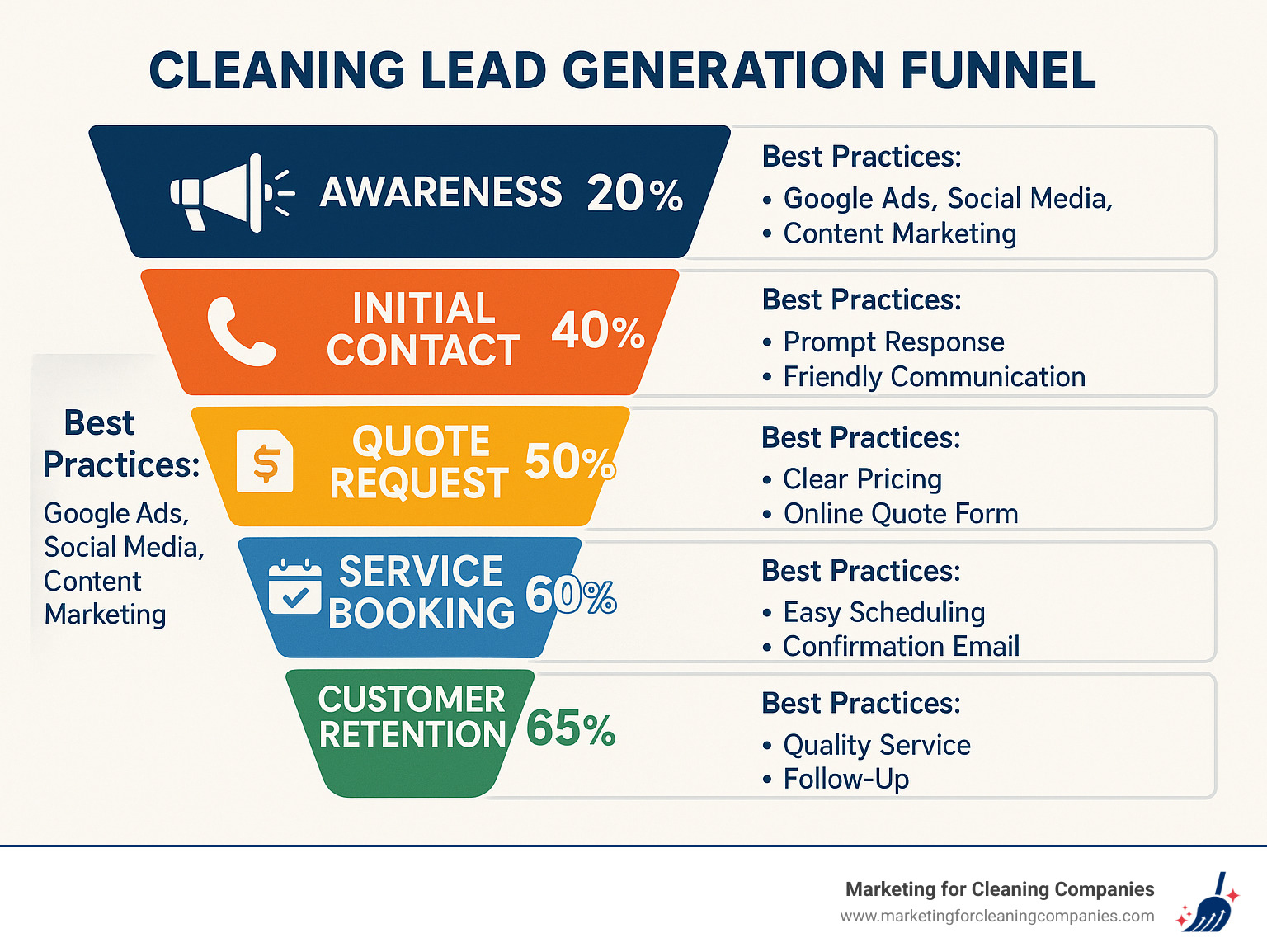
Think of lead generation as building a bridge between your great cleaning team and people desperate for help. A lead is anyone who shows interest (fills out a form, calls, or messages). A prospect is a lead that actually fits your ideal customer profile and can afford you.
Cleaning markets break down into:
• Residential – busy homeowners booking recurring or one-off deep cleans.
• Commercial – offices, medical sites and schools that require formal bids.
• Speciality niches – carpet, post-construction, biohazard, or window cleaning.
Quality always beats quantity: commercial leads often convert at 40–50 %, while well-qualified residential prospects easily top 30 % when followed up quickly.
Core Principles
- Lead magnets – free checklists, product guides or limited-time offers that capture contact details.
- Focused landing pages – one clear headline, benefit-driven copy, social proof and a mobile-friendly form.
- Consistent follow-up – days 1, 2, 4, 7, then monthly via calls, email or text.
- Trust signals – reviews, insurance certificates, employee photos and before-and-after images.
Which Leads Fit Which Cleaner?
• Small residential teams thrive on recurring housekeeping contracts.
• Deep-clean/move-out jobs add profitable one-off bursts.
• Medical, industrial and educational facilities suit established commercial firms with specialised equipment.
• Biohazard or high-rise window work commands premium rates but requires extra certification.
Match your capacity and skills to the right market, and you’ll convert more leads while avoiding costly mismatches.
Lead Generation for Cleaners: High-Impact Strategies
A single channel is risky. Instead, mix inbound methods (people already searching) with outbound methods (you reach out first) to create a reliable pipeline.
Inbound tactics – SEO, optimised Google Business Profile, helpful blog posts and how-to videos – attract prospects who are actively hunting for cleaning services.
Outbound tactics – Google Ads, Local Services Ads, social ads, door hangers and cold email – put your brand in front of people before they start Googling competitors.
| Strategy | Cost to Start | Speed to Results | Best Use |
|---|---|---|---|
| Buy targeted leads | Low | Immediate | New companies testing demand |
| DIY local SEO | Low | 3–6 mo | Long-term growth on a tight budget |
Proven Online Tactics
• Google Business Profile – complete every field, post weekly updates, and add fresh photos.
• Local SEO – optimise pages for “house cleaning in [City]” and build citations on directories.
• Review marketing – request a Google review after every successful clean.
• Website quote forms – short, mobile-friendly and linked directly to your CRM.
Learn more about our Local SEO services
Quick-Win Paid Channels
• Google Ads / LSAs – bid on high-intent keywords and geo-fence your true service radius.
• Facebook Ads – target busy professionals or specific neighbourhoods with value-driven offers.
• Retargeting – stay visible to website visitors who didn’t book the first time.
See how paid ads maximise ROI for cleaners
Digital Channels Deep Dive: SEO, PPC & Social Media
SEO & Content Basics
Most homeowners search things like “best house cleaner near me” or “remove wine stain from carpet.” Build content clusters around those real questions: a main service page plus supporting how-to posts, each linking to the other. Use descriptive file names and alt text on every before-and-after photo so Google “sees” your results.
Local ranking factors still matter most. Keep your NAP (name, address, phone) identical across every directory, and add local business and review schema markup so search engines understand you are a real, trusted company.
Mastering landing pages for cleaning leads
PPC & LSAs Essentials
• Match keywords to intent – “hire office cleaning” converts; “cleaning tips” usually does not.
• Use ad extensions (call, location, sitelinks) for more real estate and higher click-through.
• Track every call and form submission so you know which ads pay off.
Social Media & Community Groups
• Facebook Groups – answer cleaning questions before pitching your services.
• LinkedIn – connect with facility managers and discuss healthy workplace topics.
• TikTok / #CleanTok – quick, satisfying cleaning changes attract thousands of local viewers.
Offline & Referral Engines That Still Shine
Digital gets the buzz, but classic tactics still deliver excellent lead generation for cleaners.
• Door hangers – target move-in dates or spring-cleaning season in affluent areas.
• Local papers & community newsletters – homeowners still read them on weekends.
• Strategic partners – real-estate agents, interior designers and contractors constantly need trustworthy cleaners.
• Networking groups – consistent attendance at your chamber of commerce builds long-term referral streams.
• Review incentives – small discounts for honest Google reviews amplify social proof.
• Gamified referral programmes – tiered rewards (20 %, 30 %, 50 %) encourage multiple referrals.
Niche Targeting
Specialising helps you stand out and charge premium rates:
• Schools – steady contracts with predictable budgets.
• Healthcare – infection-control expertise commands higher pricing.
• Post-construction – less competition and bigger invoices.
• Eco-friendly cleaning – appeal to green-minded neighbourhoods.
• High-rise windows – high risk, high reward.
Try UpLead to build a hyper-targeted prospect list
Tracking, Tools & ROI Measurement
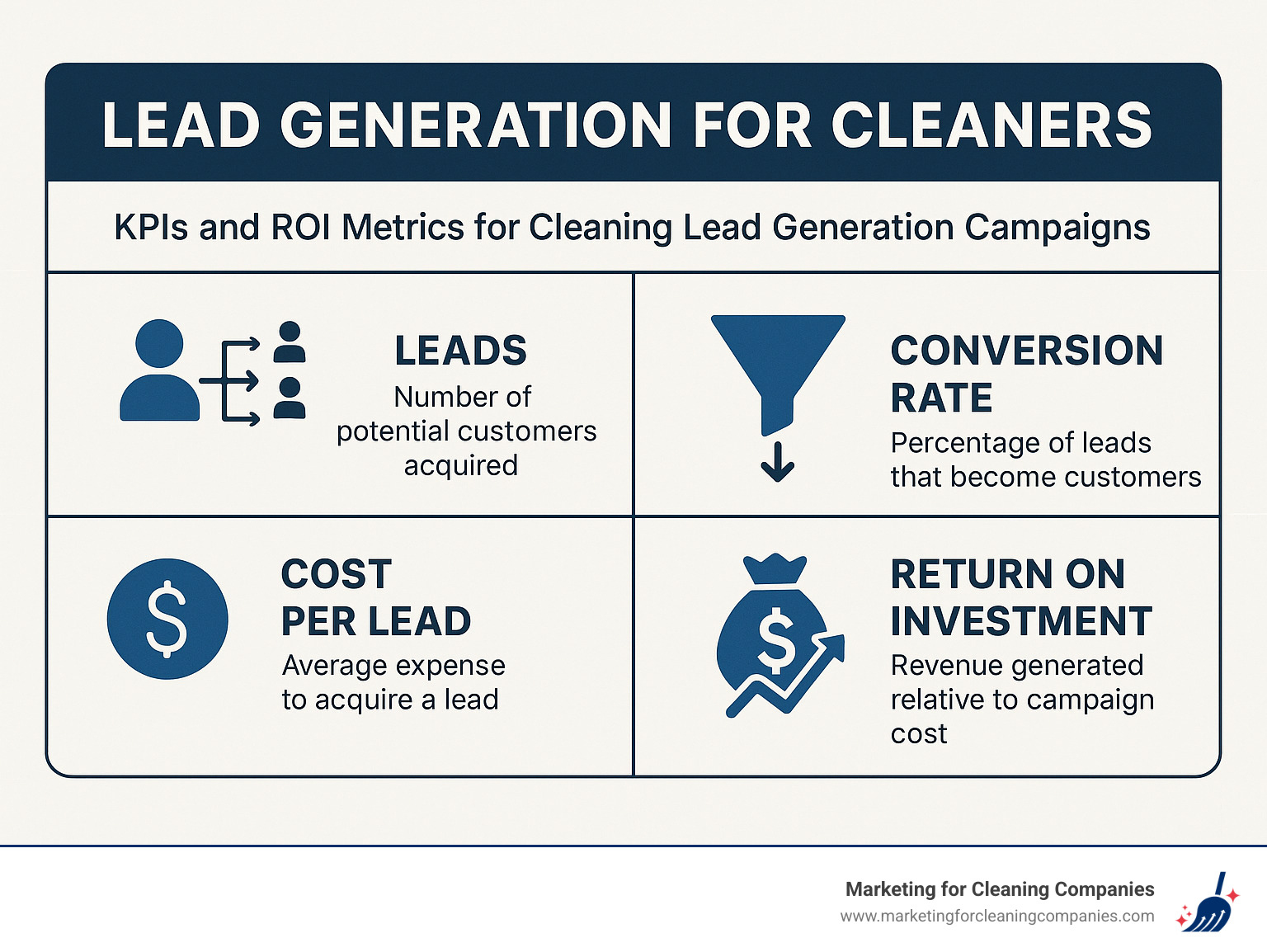
“What gets measured gets improved.” A simple CRM is non-negotiable. Track source, follow-ups and conversions for every lead, then double down on what works.
Key numbers to watch:
• Cost per lead (CPL) – total marketing spend ÷ leads received.
• Conversion rate – leads that become paying customers.
• Average customer value – one-time invoice or annual recurring revenue.
• Customer lifetime value (CLV) – total revenue expected over the relationship.
Smart tools for cleaners:
• Scheduling + online booking that syncs with your CRM.
• Call-tracking numbers for each campaign.
• Email drip sequences that nurture undecided prospects automatically.
• A dashboard (Google Looker Studio works) pulling data from ads, calls and revenue.
Benefits of lead scoring for cleaning companies
Calculating True ROI
Separate fixed costs (software, base ad budget) from variable costs (lead fees, commissions). If your average client is worth $500 annually and you close 30 % of leads, anything under $150 per lead is profitable. Break-even math like this keeps spending in check while you scale.
Frequently Asked Questions about Cleaning Leads
What does an effective follow-up sequence look like?
Call new leads within an hour, then follow the 1-2-4-7-30 cadence: day 1, day 2, day 4, day 7, then monthly. Mix phone, email and SMS and provide value each time (tips, testimonials, easy scheduling links).
How much should I budget per lead?
Residential leads typically run $8–25. Commercial or specialised services can range from $15–80+. Focus on cost per customer instead of cost per lead: a $30 exclusive lead that converts half the time is cheaper in the long run than a $5 shared lead that almost never closes.
How do I guarantee purchased leads are exclusive?
Work only with providers that put exclusivity in writing and deliver leads in real time. Test with a small order, track conversion rate closely and watch for sudden drops that suggest the same prospect was sold to multiple cleaners.
Conclusion & Next Steps
Lead generation isn’t one tactic; it’s a system. Start with the essentials: claim your Google Business Profile, add conversion tracking to your website and create a simple referral reward. Next, choose one paid or organic channel to test, measure results, then scale what works.
Marketing for Cleaning Companies specialises in building those data-driven systems for cleaners nationwide. When you’re ready to fill your calendar with qualified jobs, let’s talk.
Learn more about our proven SEO programmes