Why Cleaning Business Growth Strategies Matter More Than Ever in 2025
Cleaning business growth strategies are essential for surviving and thriving in today’s competitive market. The global cleaning services industry reached $415.93 billion in 2024 and is projected to grow at 6.9% annually through 2030. But here’s the catch – while demand is booming, competition is fiercer than ever.
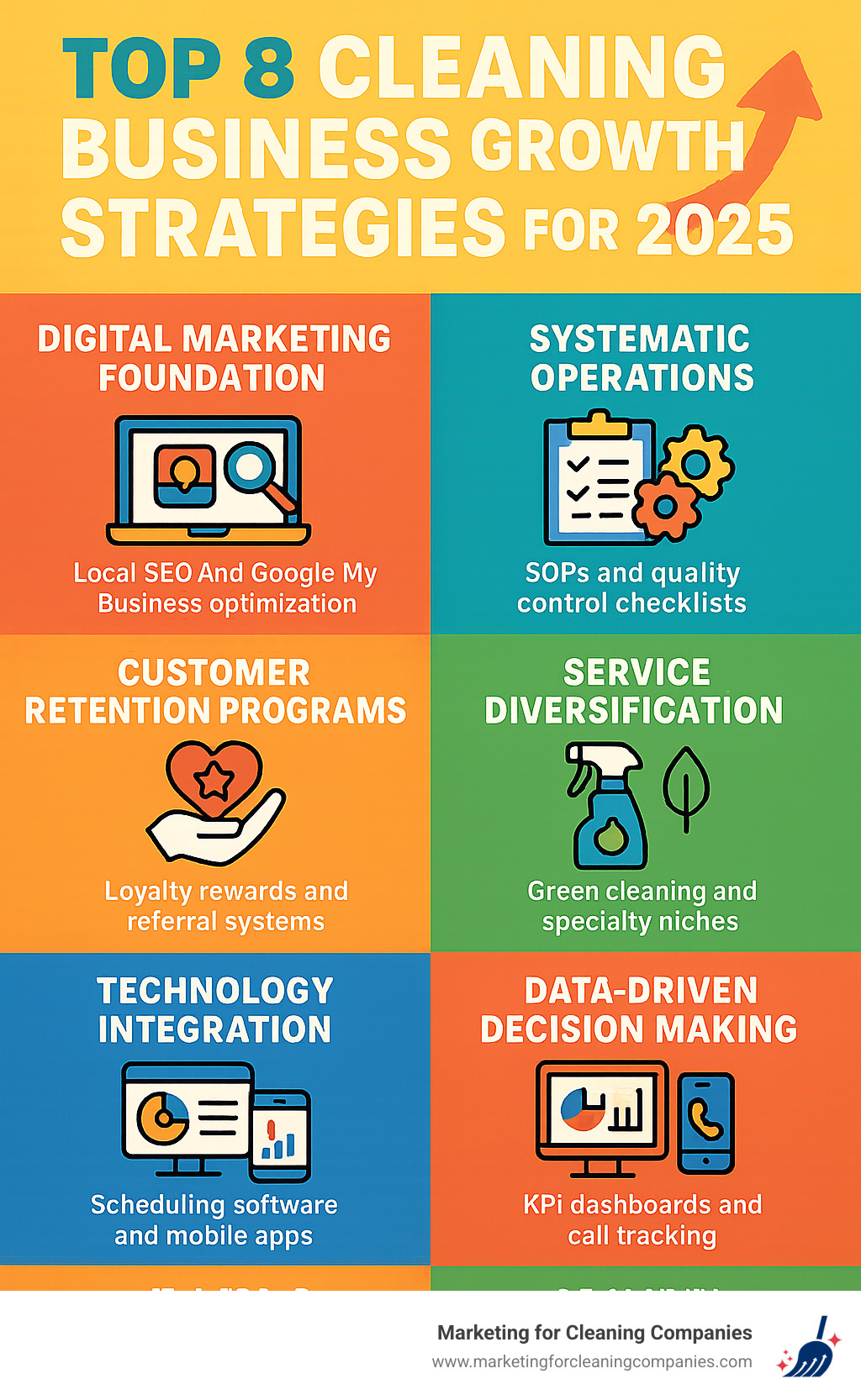
The most effective cleaning business growth strategies for 2025 include:
- Digital-first marketing – Local SEO, Google Ads, and reputation management
- Operational systems – SOPs, quality control, and cleaning software integration
- Service diversification – Green cleaning, specialty niches, and premium offerings
- Customer retention – Loyalty programs, upselling, and referral systems
- Technology adoption – Scheduling software, mobile apps, and automated workflows
- Data-driven decisions – KPI tracking, call analytics, and performance metrics
The cleaning industry is experiencing massive shifts. 53% of revenue now comes from ongoing contracts, not one-time jobs. 98% of consumers read online reviews before hiring local services. The cleaning software market is exploding at 10.3% annual growth as businesses demand efficiency.
Yet many cleaning business owners are stuck working 70-hour weeks while profits shrink. They’re chasing new customers instead of maximizing existing relationships. They’re using outdated marketing tactics that worked in 2015 but fail today.
The winners are those implementing modern cleaning business growth strategies that combine digital marketing, operational excellence, and customer-centric approaches. They’re not just working harder – they’re working smarter.
I’m Kimberly Adamof, and I scaled and sold my own successful cleaning company using proven cleaning business growth strategies before founding Marketing for Cleaning Companies. I’ve helped hundreds of cleaning business owners break through growth plateaus and build profitable, scalable operations.
Cleaning business growth strategies terms made easy:
– cleaning service marketing plan
– cleaning company digital marketing
– cleaning service google ads
Top Cleaning Business Growth Strategies for 2025+
The cleaning industry has completely transformed over the past decade, and many business owners are still playing by yesterday’s rules. After analyzing hundreds of successful cleaning businesses, I’ve found that cleaning business growth strategies that actually work in 2025 are fundamentally different from what we used to do.
Here’s the reality check most cleaning business owners need:
| 2015 Tactics | 2025+ Strategies |
|---|---|
| Yellow Pages ads | Local SEO and Google My Business |
| Door-to-door flyers | Targeted digital advertising |
| Word-of-mouth only | Online reviews and reputation management |
| Manual scheduling | Automated booking systems |
| One-size-fits-all pricing | Value-based, segmented pricing |
| Basic cleaning only | Specialized services and green options |
The most successful cleaning business growth strategies revolve around three pillars: building a rock-solid digital presence, creating bulletproof operational systems, and maximizing customer lifetime value. Companies that nail all three consistently outperform competitors by 200-300%.
Why cleaning business growth strategies start with segmentation
Most cleaning business owners try to serve everyone and end up serving no one really well. The most profitable cleaning businesses have cracked the code on customer segmentation. They’ve figured out exactly who their ideal customers are and built their entire business around serving those people exceptionally well.
Residential customers typically fall into four main groups: busy professionals making $75K+ who value convenience, seniors over 65 who prioritize trust and reliability, new parents who are time-pressed and health-conscious, and high-net-worth individuals who expect premium service.
On the commercial side: small offices focused on cost-effectiveness, medical facilities with strict compliance requirements, retail spaces needing flexible scheduling, and property management companies looking for volume pricing and long-term relationships.
The cleaning companies making serious money pick one or two segments and completely dominate them. This laser focus lets them develop specialized expertise, create resonant marketing messages, build efficient processes, and command premium pricing.
Our Cleaning Service Marketing Plan walks you through identifying your ideal customer segments and building targeted growth strategies that actually convert.
Data-driven cleaning business growth strategies in action
The biggest gap between successful and struggling cleaning businesses is decision-making based on data versus gut feelings. The companies crushing it track everything and use real numbers to guide their growth strategies.
Key metrics include: Customer Acquisition Cost, Lifetime Value, Monthly Recurring Revenue, customer retention rates, average job sizes, lead conversion rates by channel, and employee productivity metrics.
Real example: we helped one client set up CallRail analytics tools to track which marketing efforts generated quality leads. They found their Google Ads converted 3x better than Facebook campaigns. By shifting budget to what worked, they increased ROI by 40% in three months.
Another client finded through call tracking that Google My Business leads converted at 65%, while directory site leads only converted at 23%. This insight helped them restructure their marketing and boost overall conversion rates by 28%.
The beauty of data-driven cleaning business growth strategies is eliminating guesswork. You know exactly which marketing channels work, which customer segments are most profitable, and where to invest for maximum growth.
Digital Foundations: Build & Leverage Your Online Presence
Your online presence is your 24/7 sales representative. While you’re sleeping, potential customers are searching for cleaning services online. If they can’t find you, or what they find doesn’t impress them, they’ll hire your competition.
Cleaning business growth strategies in 2025 must start with a bulletproof digital foundation. Your website, local SEO, and online reputation work together to either attract high-quality leads or send them to competitors.
Website & Local SEO Essentials for cleaning business growth strategies
Your website works against you if it takes more than three seconds to load or looks terrible on smartphones. Here’s what matters: mobile responsiveness is non-negotiable since 60% of searches happen on phones. Your online booking system should be prominent – customers want to schedule at 9 PM on Sunday, not wait until Monday to call.
Customer testimonials and before/after photos build trust faster than any sales pitch. One client added a photo gallery and saw conversion rates jump 23% within a month.
Local SEO is where the magic happens. 46% of all Google searches have local intent, and local searches convert 50% better than general searches. Someone searching “office cleaning downtown” is much more likely to hire you than someone browsing “cleaning tips.”
Your Google Business Profile deserves as much attention as your website. Keep it updated with fresh photos, respond to every review, and post weekly updates. These actions signal to Google that you’re an active, trustworthy business.
Our SEO for Janitorial Services approach has helped cleaning companies increase local search visibility by an average of 180% within six months.
Reputation & Review Management
98% of consumers read online reviews before hiring local services. 85% trust online reviews as much as personal recommendations. Your star rating directly impacts your bottom line – BrightLocal review statistics show businesses with 4+ star ratings get 70% more clicks than lower-rated competitors.
The best time to ask for reviews is immediately after delivering exceptional service. Send follow-up emails with direct links to your Google Business Profile. Make it as easy as possible for happy customers to share their experience.
Responding to reviews – both positive and negative – shows potential customers you care about service quality. For negative reviews, respond quickly and professionally. Acknowledge concerns, take responsibility where appropriate, and offer to resolve issues privately.
Paid Ads, Call Tracking & ROI
Organic growth takes time, but paid advertising delivers qualified leads starting today. Google Ads work best when you focus on local service keywords like “house cleaning [your city]” and commercial intent terms like “office cleaning services.”
Retargeting campaigns are incredibly effective. When someone visits your website but doesn’t book immediately, you can show them targeted ads with special offers. We’ve seen retargeting campaigns convert 3-5 times better than general advertising.
Our Effective Strategies for Using Google Ads to Promote Your Cleaning Business guide reveals exact targeting and messaging strategies that generate the highest ROI.
Call tracking transforms advertising from guesswork into science. You’ll know exactly which ads generate phone calls and which turn into paying customers.

One client found through call tracking that “emergency cleaning” ads generated leads worth three times more than general cleaning ads, even though clicks cost 40% more. This insight helped them shift budget allocation and increase profitability by 60%.
Operational Excellence & Technology for Scale
You can’t scale chaos. I’ve seen cleaning company owners hit walls because they tried to grow without proper systems. They end up working 80-hour weeks while profit margins shrink and service quality suffers.
The most effective cleaning business growth strategies require rock-solid operations that maintain quality while reducing your personal involvement. This isn’t just about getting bigger – it’s about getting better and more profitable.
Systems, SOPs, and Quality Control
Standard Operating Procedures are your ticket to freedom. SOPs are the backbone of scalable cleaning operations – they ensure consistent results whether you’re there or not.
Your cleaning business needs SOPs for everything: client onboarding, service delivery checklists, quality control inspections, customer communication, equipment maintenance, safety protocols, and employee training. Yes, it takes time to create these systems, but the payoff is huge.
Standardized checklists alone can reduce training time by 40% and improve service consistency by 65%. They allow you to maintain quality standards as you grow your team. New employees follow proven processes instead of guessing.
Quality control becomes systematic too. Implement random inspections on 10-15% of jobs, send customer feedback surveys after each service, require photo documentation of completed work, and track performance scorecards for each team member.
Companies that implement systematic quality controls see 23% higher customer retention rates and 31% more referrals compared to those that wing it.
Smart Tech: Software, Automation, Robotics
The cleaning software market is exploding at 10.3% annual growth because smart technology delivers real ROI. I’ve watched cleaning companies reduce administrative time by 50% while improving customer satisfaction.
The right software stack transforms operations. You need scheduling and dispatch systems, customer relationship management, invoicing and payment processing, employee time tracking, quality management tools, and financial reporting dashboards.
Mobile apps are game-changers for field operations. Your cleaning teams need real-time schedule updates, customer contact information, service checklists, photo upload capabilities, time tracking, and communication tools – all in their pocket.
Emerging technologies include UVC disinfection robots for commercial spaces, IoT sensors that monitor supply levels, AI-powered scheduling optimization, automated customer communication systems, and predictive maintenance alerts.
Latest research on green equipment shows smart cleaning technology isn’t just about efficiency – it’s about sustainability and health too.
One client went from spending 15 hours per week on scheduling and billing to just 6 hours after implementing integrated software. That’s a 60% reduction in administrative overhead – time now spent on business development and customer relationships.
Financial & KPI Dashboards
Most cleaning business owners are flying blind financially. They know their bank balance but don’t know which services are profitable, which customers cost money, or which marketing channels work.
You can’t manage what you don’t measure. Successful cleaning businesses track everything using dashboard systems that provide actionable insights.
Critical financial metrics: gross profit margin by service type, customer acquisition cost by channel, average revenue per customer, cash flow projections, equipment utilization rates, and labor efficiency ratios.
Operational KPIs: schedule adherence rates, customer satisfaction scores, employee productivity metrics, quality control pass rates, equipment downtime, and safety incident tracking.
Cost-per-square-foot analysis is particularly powerful. Most cleaning companies undercharge by 15-25% because they don’t accurately track true costs. Proper financial tracking often reveals immediate opportunities to increase profitability without losing customers.
Our Cleaning Business Marketing Ideas resource includes templates for building comprehensive KPI dashboards that drive profitable growth.
Retention, Upselling, and Expansion Tactics
Acquiring new customers costs 5-7 times more than keeping existing ones. Yet I see cleaning business owners spend 80% of their energy chasing new clients while existing customers quietly slip away to competitors.
The most successful cleaning business growth strategies flip this approach. They focus on creating customers for life, not just one-time transactions. When you master retention and expansion, your business starts growing from the inside out.
Customer Loyalty Loops for cleaning business growth strategies
Building customer loyalty requires intentional systems that create genuine connections and make it harder for customers to leave than to stay.
The foundation starts with onboarding. Within 24 hours of a new customer booking, someone from your team should call to welcome them personally. This isn’t a sales call – it’s about setting expectations and showing you care.
During that first pre-service walkthrough, introduce team members by name. Explain your quality guarantee clearly. Ask about specific concerns and preferences. This personal touch immediately sets you apart from competitors who just show up and start cleaning.
Regular check-ins and satisfaction surveys keep you connected to customers’ changing needs. One client found through surveys that 60% of customers wanted eco-friendly products but were afraid to ask. They pivoted to green cleaning and increased retention by 40%.
Referral programs create win-win situations that generate your highest-quality leads. When Mrs. Johnson refers her neighbor, that neighbor already trusts you before you meet. Offer meaningful rewards – like a free cleaning to the referrer and discount to the new customer.
Surprise and delight moments matter too. Send handwritten thank-you notes after first cleanings. Remember their dog’s name. Notice when they mention special events and ask how they went. These small gestures create emotional connections that transcend price competition.
Our Lead Generation for Cleaners program includes proven templates for building these loyalty systems. Our most successful clients tell us 25-40% of new business comes from referrals.

Diversify Services & Enter New Niches with cleaning business growth strategies
Service diversification works because it increases your value to existing customers. When you can handle carpet cleaning, window washing, and post-construction cleanup, you become their go-to solution for everything. This makes you stickier and more profitable.
Carpet and upholstery cleaning is often the easiest addition because it complements existing services perfectly. One client invested $15,000 in equipment and training, then generated an additional $180,000 in revenue in their first year. Their average job value increased by 45% because customers bundled services.
Green cleaning represents a massive opportunity growing 15% annually. Customers pay 10-20% premiums for certified eco-friendly services. Getting Green Seal certification or using EPA Safer Choice products differentiates you while commanding higher prices.
Post-construction cleanup and move-in/move-out services offer excellent margins because they’re project-based rather than recurring. These jobs often pay 2-3 times more than regular cleaning because they require specialized skills.
Medical facility cleaning requires additional training and compliance knowledge, but barriers to entry mean less competition and higher rates. Crime scene and trauma cleanup is specialized work that commands premium pricing.
The vacation rental market has exploded with Airbnb and VRBO growth. These properties need reliable, fast turnaround cleaning between guests. The volume-based nature provides steady income streams.
Window cleaning and pressure washing are natural extensions that leverage existing customer relationships. Many cleaning companies add these services and see immediate revenue upticks because they’re selling to customers who already trust them.
The key is choosing services that make sense for your market and capabilities. Don’t try to be everything to everyone – pick 1-2 complementary services and master them completely.
Frequently Asked Questions about Cleaning Business Growth Strategies
What is the most cost-effective marketing channel?
Local SEO consistently delivers the highest ROI for cleaning businesses. I’ve watched companies get 65-75% conversion rates from organic search leads, while paid advertising typically converts at 25-35%.
But local SEO takes time and expertise. The smartest approach combines multiple channels. Google My Business optimization costs nothing but time. Customer referral programs have low costs but incredibly high conversion rates. Email marketing to existing customers is practically free money.
Most successful cleaning companies allocate marketing budgets like this: 40% to SEO and local search, 30% to paid advertising, 20% to retention and referral programs, and 10% to testing new channels.
How do I maintain service quality while scaling?
Quality maintenance during scaling requires three pillars: documentation, training, and monitoring.
Start with bulletproof systems. Create detailed SOPs for every service type. Develop property-specific checklists your team can follow even on their worst days. Document customer preferences so nothing falls through cracks.
Your training program becomes your secret weapon. Companies that invest in employee training are 17% more productive and 21% more profitable. Create comprehensive onboarding programs, provide ongoing skills development, and set up mentorship programs.
Technology makes the difference between hoping quality stays high and knowing it does. Use mobile apps for real-time quality tracking. Require photo documentation of completed work. Deploy customer feedback systems that catch problems before they become complaints.
When should I hire and train additional staff?
Watch for these capacity indicators: you’re consistently booked 2-3 weeks in advance, you’re turning away new customers regularly, you’re working more than 50 hours per week consistently, or customers are complaining about scheduling delays.
But capacity isn’t enough – you need financial readiness too. Have 3-6 months of operating expenses in reserve. Make sure gross profit margins are above 50%. Understand customer acquisition costs. Most importantly, have predictable monthly recurring revenue.
Operational readiness matters just as much. You need documented training processes, standardized service procedures, quality control systems, and management systems that can handle increased complexity.
Here’s my rule: hire when you’re at 80% capacity and have 2-3 months of new hire costs in reserve. This timing lets you train properly without financial pressure while capturing growth opportunities.
Conclusion
Growing a cleaning business in today’s market isn’t just about working harder – it’s about working smarter. The cleaning business growth strategies we’ve explored aren’t theoretical concepts. They’re proven approaches that real cleaning companies are using to build profitable, scalable operations while their competitors struggle to keep up.
The numbers don’t lie. The cleaning industry will reach $476 billion by 2028, but this growth won’t be distributed equally. The winners will be those who accept digital marketing, systematize their operations, and focus relentlessly on customer relationships.
Think about where your business stands right now. Are you still relying on word-of-mouth and hoping for the best? Are you working 70-hour weeks while your profits shrink? Are you turning away customers because you can’t handle the volume, but afraid to hire because you don’t have systems in place?
Here’s what we’ve learned from helping hundreds of cleaning business owners transform their operations: success comes from implementing the right strategies in the right order. You can’t skip steps. You need digital foundations before you can scale with paid advertising. You need operational systems before you can hire confidently. You need retention strategies before you can maximize customer lifetime value.
The most successful cleaning companies we work with share common traits. They segment their markets ruthlessly instead of trying to serve everyone. They build their online presence systematically rather than hoping customers will find them. They create processes that work without constant oversight instead of being trapped in day-to-day operations.
But here’s the part that might surprise you: these strategies aren’t complicated. They just require consistent execution and a willingness to think differently about your business. The cleaning company owner who implements local SEO properly will outcompete the one who relies on flyers every single time. The business that tracks their KPIs will make better decisions than the one that operates on gut feelings.
At Marketing for Cleaning Companies, we’ve seen this change happen again and again. A residential cleaning service in suburban Chicago increased their monthly revenue from $12,000 to $38,000 in eight months by implementing these exact cleaning business growth strategies. A commercial cleaning company in Phoenix went from 15 clients to 47 clients while reducing their owner’s work hours by 30%.
The opportunity is massive, but only for those who act. Your competitors are either stuck in old-school thinking or just starting to figure out these strategies. That gives you a window of opportunity – but it won’t stay open forever.
Start with your digital foundation. Our Maximize Your ROI: Investing in Local SEO for Your Cleaning Business guide will help you build the online presence that drives qualified leads to your business. Then systematically implement the operational and retention strategies we’ve outlined.
Cleaning business growth strategies aren’t one-time fixes – they’re ongoing processes. The market keeps evolving, customer expectations keep rising, and new technologies keep emerging. The businesses that commit to continuous improvement and strategic thinking will dominate their markets for years to come.
Your cleaning business has incredible potential. The demand is there, the margins can be excellent, and the barriers to implementing these strategies are lower than ever. The only question is whether you’ll take action or keep doing things the way you’ve always done them.
The choice is yours. But choose quickly – your competitors are already making their moves.